AUSSIE BEE BULLETIN
Aussie Bee > Aussie Bee, Bulletin of the Australian Native Bee Research Centre.
From 1997 to 2001, we published 18 issues of a hardcopy magazine on native bees. It was called Aussie Bee, Bulletin of the Australian Native Bee Research Centre.
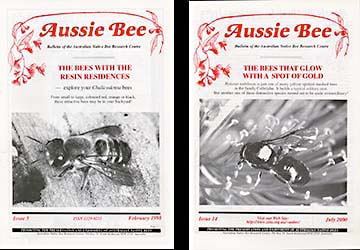
Above: Two issues of our hardcopy magazine, Aussie Bee Bulletin.
Aussie Bee Bulletin covered a wide array of native bee topics, such as the following...
Major types of Australian native bees, including:
-- Stingless bees;
-- Blue banded bees;
-- Carpenter bees;
-- Reed bees;
-- Teddy bear bees;
-- Leafcutter bees;
-- Resin bees;
-- Banksia bees;
-- Masked bees.
Pollination of wildflowers and crops, including:
-- Buzz pollination;
-- Dendrobium orchids and Hylaeus bees;
-- Melastoma affine and carpenter bees;
-- Persoonia and Leioproctus bees;
-- Avocado and stingless bees;
-- Capsicums and Tetragonula bees;
-- Lucerne and leafcutter bees;
-- Tomatoes and blue banded bees.
Keeping stingless bees, including:
-- Finding nests;
-- Boxing methods;
-- Honey harvesting;
-- Predator control;
-- Strengthening hives;
-- Queen bee mating.
Exotic bee news, including:
-- European Bumblebees;
-- South African Carder Bees.
Aussie Bee's Native Bee Safaris, including:
-- Cape York;
-- The Kimberley;
-- Arnhem Land;
-- Central Australia.
...and much more!
Complete sets of Aussie Bee, Bulletin of the Australian Native Bee Research Centre are available in the National Library of Australia and the State Library of NSW. See details.
Back issues of this magazine are now sold out. However, we plan to progressively re-publish selected articles from Aussie Bee Bulletin. These will be available through Aussie Bee website.
Other Resources on Native BeesTo learn more about Australian native bees, please take a look at some of the other resources currently available on Aussie Bee website: Aussie Bee Online Aussie Bee eBooks |